
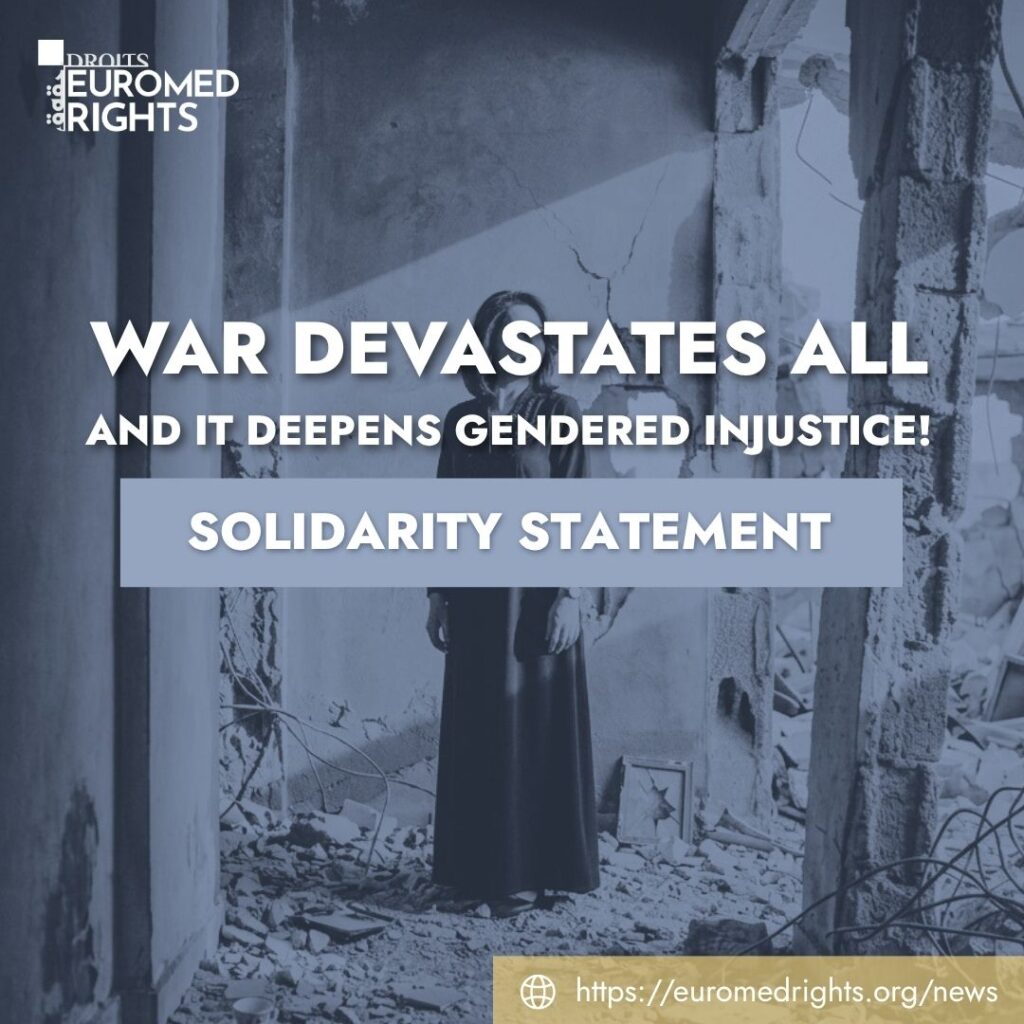
Since early March 2026, the war in Lebanon and across the Middle East has further exacerbated the humanitarian crisis already sparked by the ongoing genocide in Gaza.
Across the region, women and girls account for a significant proportion of reported victims in the recent wave of violence. They are disproportionately affected by repeated displacement, the collapse of essential services, and heightened exposure to gender-based violence.
We, members of the EuroMed Rights Regional Working Group on Women’s Rights, Gender Justice & Freedoms, express our deep concern over the gendered impacts of these wars. They mark a serious setback in the protection of the fundamental rights of women and girls to life, health, dignity, and security across the Euro-Mediterranean region.
This escalation has forced hundreds of thousands of women and girls into overcrowded shelters with no privacy. It has disrupted reproductive health services and sharply increased risks of gender-based violence, including sexual and gender-based violence.
In Lebanon alone, more than 1.2 million people have been displaced, including an estimated 620,000 women and girls, nearly one quarter of the country’s female population. Among them are 325,500 women of reproductive age, including around 13,500 who are pregnant, with an estimated 1,500 expected to give birth within the next 30 days. Many, including 1,700 pregnant women in southern Lebanon, are now cut off from essential care as health facilities are under attack or forced to close.
Across the wider Middle East, more than 18 million women and girls face heightened risks of gender-based violence due to insecurity, displacement, and the breakdown of protective environments.
In Gaza, the situation remains catastrophic. Women and girls represent nearly half of civilian casualties, while adolescent girls account for 12% of survivors of reported cases of gender-based violence. Adolescent birth rates have more than doubled compared to pre-war levels.
Beyond these immediate impacts, the consequences are profound and long-lasting. More than 260 health facilities and 14 mobile medical units have already shut down in affected areas across Gaza, Lebanon, and beyond, severely limiting access to maternal and reproductive healthcare.
Years of repeated displacement, trauma, and violence have left deep and irreversible psychological scars: in Gaza, four out of ten young people show symptoms of moderate to severe depression or anxiety, while 61 per cent exhibit signs of post-traumatic stress.
The disruption of girls’ education risks creating a lost generation, increasing the likelihood of early and forced marriages, child labor, and lifelong economic marginalization.
The war is expected to cost regional economies between 120 billion and 194 billion USD (3.7 to 6 % of GDP). Women – already overrepresented in informal employment and spending an average of 4.2 hours per day on unpaid care work – face increased loss of livelihood and heightened risks of poverty.
These disruptions carry severe intergenerational consequences, including higher rates of maternal and child health complications, entrenched gender inequalities, and long-term barriers to recovery and inclusive economic development in the region.
We are deeply concerned by persistent funding gaps that continue to hinder critical gender-based violence and maternal health responses. Many safe spaces for women and girls are closing or remain under-resourced. Without immediate and decisive action, this crisis will cause irreparable harm to generations of women and girls, while undermining the European Union’s credibility as a global defender of human rights and gender equality.
In solidarity with all women and girls affected by war and violence in the Euro-Mediterranean region, we call on the international community to condemn the gendered impacts of these wars and to support coordinated efforts to protect the rights, dignity, and safety of all women and girls in Lebanon, Gaza, Syria, and across the region, without discrimination.
- 80:20 Educating and Acting for a Better World
- Adala for the Right to a Fair Trial
- Collective of Families of the Disappeared in Algeria
- Committee for the Respect of Freedoms and Human Rights in Tunisia
- Egyptian Human Rights Forum
- Human Rights League (France)
- KAFA (Enough Violence & Exploitation)
- Kayan Feminist Organization
- KVINFO – Danish Centre for Gender, Equality and Diversity
- Lebanese Center for Human Rights
- Mediterranean Institute of Gender Studies
- Moroccan Organization for Human Rights
- National Federation Solidarité Femmes
- Network of Women Against Violence (Italy)
- New Woman Foundation
- Palestinian Center for Human Rights
- Tunisian Association of Democratic Women
- Tunisian League for Human Rights
- UK Women’s Budget Group
- Women Without Violence International Foundation
- Women’s Centre for Legal Aid and Counselling (WCLAC)
- Center for Egyptian Women’s Legal Assistance