
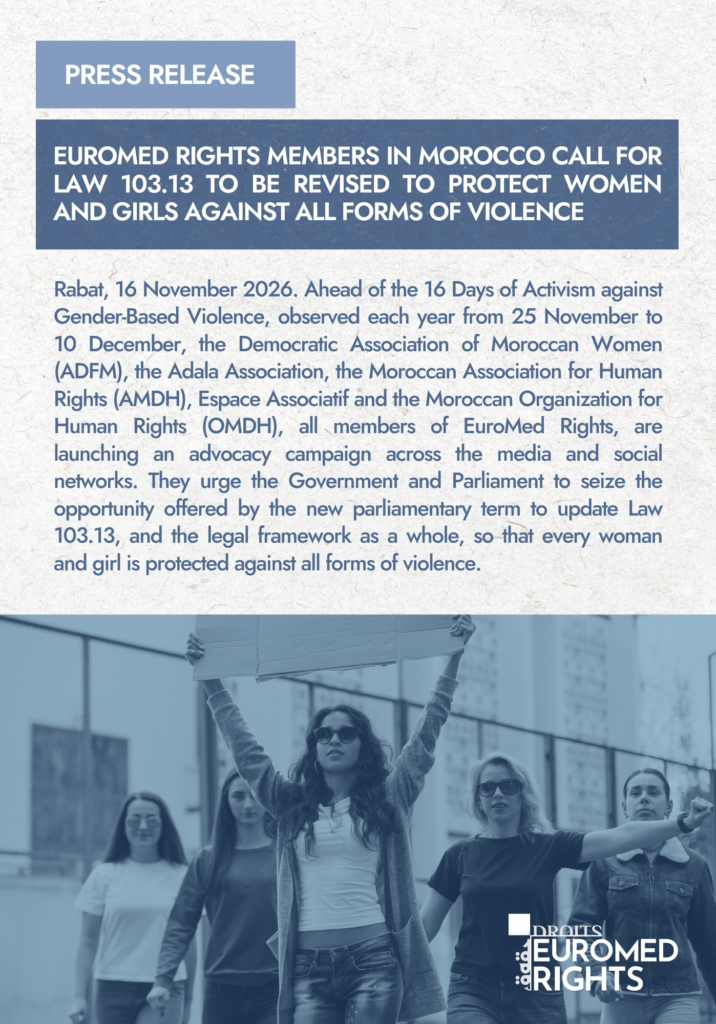
Rabat, 16 November 2026.
Ahead of the 16 Days of Activism against Gender-Based Violence, observed each year from 25 November to 10 December, the Democratic Association of Moroccan Women (ADFM), the Adala Association, the Moroccan Association for Human Rights (AMDH), Espace Associatif and the Moroccan Organization for Human Rights (OMDH), all members of EuroMed Rights, are launching an advocacy campaign across the media and social networks. They urge the Government and Parliament to seize the opportunity offered by the new parliamentary term to update Law 103.13, and the legal framework as a whole, so that every woman and girl is protected against all forms of violence.
Law 103.13, which came into force in 2018, marked a significant step forward in combating violence against women and girls. Yet the law itself has failed to address the many forms of violence that women and girls endure: domestic, sexual, economic, digital and political violence, up to and including femicide. The law neither names nor criminalizes every one of these forms, and it still falls short in protecting those who suffer them. The EuroMed Rights member associations are therefore calling for a comprehensive, coherent and concerted reform pursuing a single goal: to guarantee women and girls a unified and protective legal framework, consistent with Morocco’s international commitments, that guarantees the prevention of violence, the protection of victims, the punishment of perpetrators and reparation.
A woman at the helm of government, yet women candidates remain targets of political violence.
The appointment of Ms. Fatima Zahra El Mansouri as Head of Government, following the legislative elections of 23 September 2026, was welcomed by EuroMed Rights members and by feminist and human rights organizations alike.
Yet the election campaign also laid bare the obstacles that women still face in political life. According to Ministry of the Interior figures, women headed only 121 of the 1,615 local lists, or 7.49%. Those who did run were targeted by online campaigns of exceptional virulence. Between 10 and 23 September, the National Observatory for Protection against Digital Violence monitored 42 women heading local electoral lists and recorded 628 hostile contents aimed at them, most of which were posted on Facebook. Three quarters of these (76.6%) were defamatory, and 69.4% contained hate speech or sexist degrading language. Threats, invasions of privacy, rumors and even images faked using artificial intelligence complete the picture.
These attacks go well beyond the bounds of political debate: they target candidates because they are women, which may deter other women from running for office. While the electoral law, modernized in January 2026, now takes social networks and artificial intelligence into account, gender-based political and digital violence remains undefined in both Law 103.13 and the Penal Code.
“When a candidate is insulted because she is a woman, democracy is in retreat. Women’s participation in political life is a right guaranteed by the Constitution, not a favor. It is time for the law to guarantee protection to those who have the courage to step forward,” stresses Khadija Ainani, member of the Central Bureau of the Moroccan Association for Human Rights (AMDH) and Vice-President of EuroMed Rights.
Over half of Moroccan women affected by overlapping forms of violence
Political violence is but one facet of a far broader phenomenon. According to the latest national survey by the High Commission for Planning (HCP, 2019), 57.1% of women aged 15 to 74, some 7.6 million citizens, had experienced at least one form of violence over the course of the year. This violence takes many forms, which frequently overlap. Psychological violence affects 47.5% of women (6.4 million), economic violence 14.3% (1.9 million), sexual violence 13.6% (1.8 million) and physical violence 12.9% (1.7 million). The home remains the most dangerous place of all: nearly 46% of women, or 5.3 million, have at some point experienced violence at the hands of a current or former intimate partner.
Yet this daily reality remains largely shrouded in silence. Only 10.4% of victims of physical or sexual violence take legal action or file a complaint, a figure that drops to 3% for sexual violence. Fear of reprisals, family pressure, economic dependence: the reasons for this silence are well known, and the law has the means to address them. Beyond these figures, several forms of violence are either absent from Law 103.13 or not clearly identified in it: political violence, but also technology-facilitated violence and femicide.
Digital violence: a threat the law fails to name
With the rise of social networks, technology-facilitated gender-based violence (TFGBV) has proliferated. According to the HCP, it affects 13.8% of women online, or 1.5 million Moroccan women, in the form of online harassment, non-consensual sharing of intimate images, blackmail, threats and identity theft.
Since 2018, the Penal Code has punished certain of these practices, such as the dissemination of photographs or statements without consent (Articles 447-1 to 447-3) and harassment through online messages. Law 103.13, however, does not define digital violence as such. In the absence of a clear framework, many victims do not know where to turn, and evidence, which is quickly deleted, proves difficult to preserve.
Femicide: breaking the silence surrounding a nameless tragedy
At the end of the spiral of domestic violence, the irreparable sometimes occurs. Yet to this day, there are no official statistics on femicide in Morocco. Only sporadic counts, compiled from press reports, offer a glimpse of its scale without being able to measure it. Many of these tragedies are preceded by known and repeated violence that could have been reported and addressed.
Under the law, these killings are tried as ordinary homicides (Articles 392 and 393 of the Penal Code), with no specific legal classification and no gender-related aggravating circumstance. As long as they are neither named nor counted, they will remain difficult to prevent. Documenting the phenomenon and producing regular official statistics is therefore an essential first step.
“What is not counted cannot be combated. We are calling on the State to document femicide and all forms of violence against women and girls, with official statistics published every year, and to involve the associations that support women on a daily basis,” says Latifa Soufiani, President of Espace Associatif, a member organization of the EuroMed Rights Steering Committee in Morocco.
Law No. 103.13: incomplete protection, persistent gaps
Law 103.13 brought notable advances: a first definition of violence against women, harsher penalties, the criminalization of forced marriage and sexual harassment, as well as support units and protection mechanisms. Yet its implementation has also exposed serious limitations.
The first is that protection often comes too late. Measures such as removing the aggressor from the household remain contingent on the filing of a complaint and are not ordered by the court on its own motion. For certain offenses, such as forced marriage, withdrawing the complaint ends the prosecution, leaving victims exposed to pressure from those around them. Sexual harassment, meanwhile, although now a criminal offense, remains difficult to prove and is rarely prosecuted, particularly in public spaces and in the workplace. This calls for emergency protection orders that are immediately enforceable, issued on the basis of an individual risk assessment, that bar the aggressor from contacting or approaching the victim, and whose implementation is monitored, with action taken whenever they are breached.
The law also leaves many women and girls in its blind spot. Single mothers, migrant women and women with disabilities face specific obstacles in reporting violence, obtaining protection and accessing justice, yet no provision takes these obstacles into account. Nor does the law define domestic, digital or political violence, and marital rape is not explicitly recognized. Nor does it address the secondary victimization that women and girls suffer during reporting, investigation and trial, such as having their accounts called into question or being pressured to withdraw their complaint or accept conciliation; it guarantees neither a dignified reception nor confidentiality, nor interpretation and reasonable accommodation for women with disabilities. Finally, the support system is under-resourced: the units do not operate full time, emergency shelter places are scarce, and there is no fund to compensate victims when the perpetrator is insolvent. Protection is incomplete without guaranteed legal aid and judicial assistance, psychological and social support, easier access to medical examinations and certificates, and the documentation of evidence, including digital evidence, without saddling victims with costs that stand in the way of redress.
“Today, a woman has to choose between her safety and her complaint. That is not genuine access to justice. Protection must be granted at the first signs of danger, without waiting for proceedings, and no victim should ever be sent back to face her aggressor in the name of conciliation,” explains Jamila Sayouri of the Adala Association for the Right to a Fair Trial, a member organization of the EuroMed Rights Steering Committee in Morocco.
Legislation that must move in step
The shortcomings of Law 103.13 do not stem from its content alone. The law operates within a body of legislation that, on several points, curtails its reach. Its revision will therefore bear full fruit only if these other texts evolve in the same direction.
This applies first and foremost to the Penal Code. By criminalizing sexual relations outside marriage (Article 490), it exposes a woman who reports a rape but cannot prove her lack of consent to prosecution in her own right, which deters many from filing a complaint. It also provides a mitigating excuse for murder committed upon discovering adultery in flagrante delicto (Article 418), and it classifies rape among offenses “against family order and public morality” rather than among offenses against the physical integrity of persons. The Code of Criminal Procedure is no less problematic: the new provisions of Articles 41 and 41-1 have broadened the scope of conciliation and mediation as alternatives to prosecution without explicitly excluding offenses of violence against women and girls, including certain offenses of assault and battery. This raises serious concerns that victims may be subjected to family or social pressure to withdraw their complaints, and calls for explicit statutory safeguards so that conciliation and mediation are never used at the expense of the safety of women and girls and of their rights to protection, redress and an end to impunity.
The Family Code, whose reform is still under way, is equally at issue. It retains child marriage, polygamy and inequalities in divorce, guardianship and inheritance, all of which leave many women in a position of dependence and make it harder for them to leave a violent home. Beyond Law 103.13, what is needed is therefore a comprehensive overhaul of the Penal Code and a reform of the Family Code, in line with Article 19 of the Constitution, which enshrines equality between women and men, and with Morocco’s international commitments, in particular the Convention on the Elimination of All Forms of Discrimination against Women (CEDAW).
“A woman who has been raped should never fear being prosecuted in turn. As long as our laws contradict one another, Law 103.13 will protect with one hand what other provisions undermine with the other. We are calling for a coherent, cross-cutting reform carried out in a single, unified effort,” argues Naoufal Bouamri, President of the OMDH, a member organization of the EuroMed Rights Steering Committee in Morocco.
Six priority areas for the Government and Parliament
To this end, EuroMed Rights members call on the Government and Parliament to revise Law 103.13 along six lines of action:
- Naming and defining every form of violence: defining domestic, technology-facilitated and political violence in Law 103.13, and recognizing femicide both as a specific form of homicide and as an aggravating circumstance.
- Guaranteeing protection before a complaint is filed: empowering the public prosecutor and the judge to order emergency measures on their own motion, ensuring that complaints are systematically registered and that risk is assessed individually by trained officers.
- Removing barriers to justice: overhauling the Penal Code, explicitly criminalizing marital rape, repealing Article 490 and the mitigating excuse under Article 418 of the Penal Code, explicitly excluding conciliation and mediation in cases of violence.
- Protecting women engaged in public life, both online and offline, and making digital attacks easier to prove.
- Supporting the reform of the Family Code from an equality perspective, beginning with a ban on the marriage of minors.
- Resourcing the system: emergency shelters, support units operating full time, a National Commission with its own resources and a fund to compensate victims, together with earmarked budgets for the legislative reform, clear monitoring indicators and mechanisms for accountability and annual evaluation.
More broadly, EuroMed Rights members call for the comprehensive overhaul of the Penal Code and the reform of the Family Code to be set in motion, for all discriminatory laws to be brought into line with the Constitution and Morocco’s international commitments, and for this entire body of legislation to be harmonized.
“The Government has declared its resolve to combat violence against women. What we now ask for is a timetable. Revising Law 103.13 is not one option among many: it is the precondition for millions of women to be protected at last. The feminist movement stands ready to play its part,” says Amina Lotfi of the ADFM, a member organization of the EuroMed Rights Steering Committee in Morocco.
Through this campaign, EuroMed Rights members seek to raise public awareness of the scale of violence against women, including femicide, to help dismantle the stereotypes that perpetuate it, and to amplify the voices of survivors and committed advocates. They call on institutions, Parliament, the media and civil society to take action so that every woman and girl can live free from violence, and so that the law guarantees her protection and the real means to enforce that right.
Key figures
- 7.6 million women, or 57.1%, experienced at least one form of violence within a year (HCP, 2019).
- Only 3% of victims of sexual violence file a complaint (HCP, 2019).
- No official statistics on femicide to date.
- 7.49% of local lists headed by women in the 2026 legislative elections (Ministry of the Interior).
- 628 hostile items targeting 42 women heading local lists during the campaign (National Observatory for Protection against Digital Violence – 7 October 2026).
About EuroMed Rights
EuroMed Rights is one of the largest and most active networks of human rights organizations in the Euro-Mediterranean region. Founded in 1997, it brings together 68 organizations from 30 countries. Its mission is to promote and protect human rights and democracy in the southern and eastern Mediterranean and to influence the policies of key European actors toward these regions.
In Morocco, its member associations are the Democratic Association of Moroccan Women, the Moroccan Association for Human Rights, the Moroccan Organization for Human Rights, the Adala Association for the Right to a Fair Trial and Espace Associatif.
PRESS CONTACT: Dounia Z. Mseffer – +212 667 545411 – msefferdounia@gmail.com