
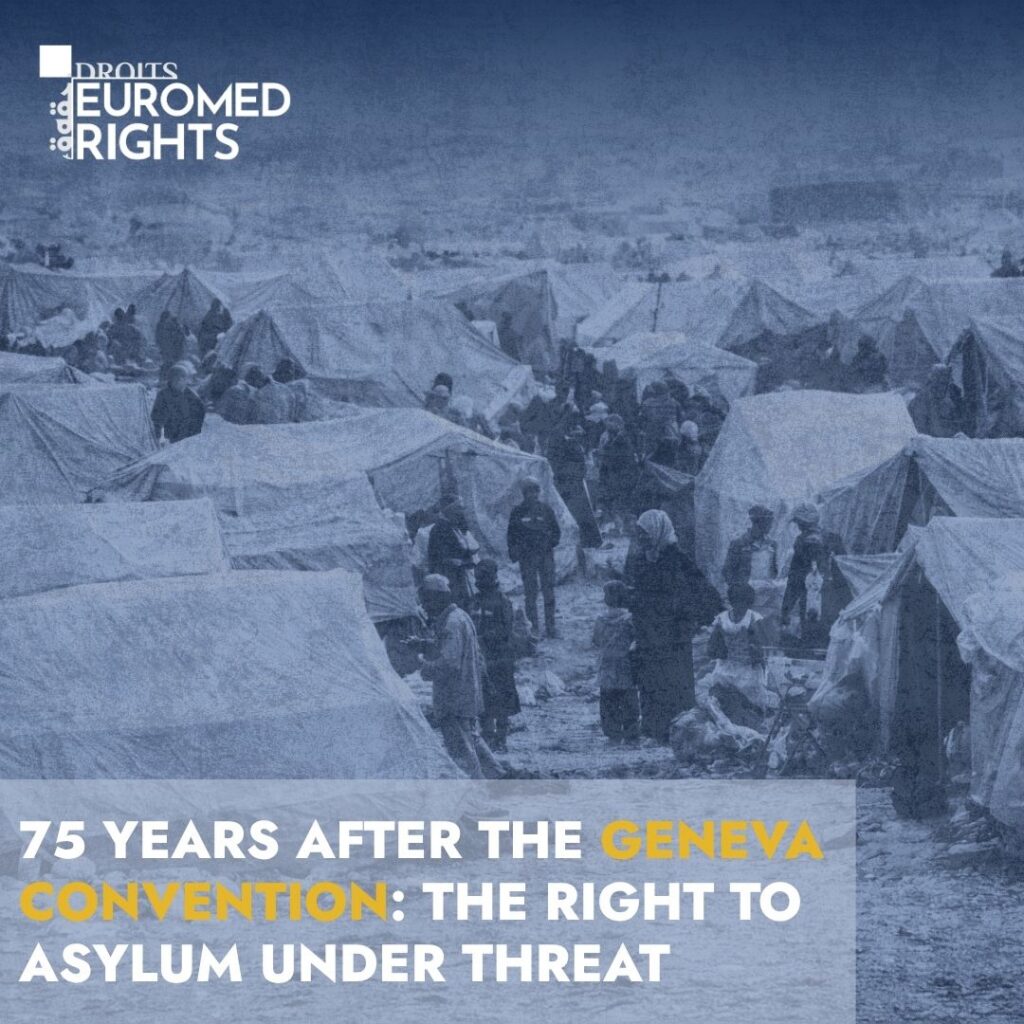
July 28th, 2026, marks the 75th anniversary of the 1951 Geneva Convention Relating to the Status of Refugees. On this occasion, EuroMed Rights calls on states to uphold their obligations under international refugee law and respect the universal right to seek asylum.
Adopted in the aftermath of World War II, this convention remains a cornerstone of international refugee law. It defines the conditions under which a person may be recognized as a refugee and specifies the obligations of States toward those fleeing persecution.
At the heart of the Convention lies the principle of non-refoulement, which prohibits the return of persons to a territory where their life and/or freedom would be threatened. For this principle to be effectively implemented, people fleeing persecution and war must have real access to the territory of states that fulfill their obligations under the Convention, and to fair asylum procedures that ensure an individualized assessment of their protection claims. In the Euro-Mediterranean region, these principles are increasingly under threat.
At the end of 2025, 117,8 million people were forcibly displaced worldwide, including 41,6 million refugees and 9 million asylum seekers. Globally, more than one in every 70 people had been forced to flee their homes. Of those, less than 8% filed a first-time asylum application in the European Union (EU) primarily in Spain, Italy, France, Germany, and Greece with close to one in four applications being filed by a minor, 21,000 of whom were unaccompanied. Yet the EU continues to treat this primarily as a security issue, denying people access to its territory, including using illegal forced returns (‘pushbacks’), which frequently entail the use of violence against people in a situation of heightened vulnerability.
The entry into force of the European Pact on Migration and Asylum, on 12 June 2026, has further consolidated this approach, while introducing an added element of institutional discrimination against persons considered to be originating form “safe countries”. Such persons, including children, are forced to remain at border zones –frequently in highly inadequate conditions while undergoing an accelerated asylum procedure which lacks necessary safeguards.
In parallel, the EU has been increasingly relying on agreements with unsafe third countries to avoid its fair share of obligations, funding equipment, training and operations aimed at preventing people from reaching its territory by irregular means, even though in the lack of legal channels to access protection in the EU, these are the sole alternative available to people fleeing persecution.
By the end of 2024, Tunisian authorities had intercepted an estimated cumulative total of more than 140,000 people across 2023 and 2024. Separate investigations have documented violent interceptions, collective expulsions, and transfers to remote border areas. In 2025, IOM recorded at least 3,403 deaths and disappearances on migration routes to Europe. On the Central Mediterranean route alone, which primarily connects Libya and Tunisia to Italy, more than 26 500 deaths and disappearances have been recorded since 2014. This is only a conservative estimate, as many shipwrecks and deaths go unrecorded.
The 1951 Convention does not automatically entitle a person to refugee status, but it does require States to assess each case individually and prohibits them from returning anyone to a territory where their rights would be at risk. Respect for this principle requires that everyone has access to an asylum procedure and that their claim is examined on an individual basis.
The Convention has been far more than a legal text. It has enabled millions of people fleeing war and persecution to find safety, reunite with their families, return to education, find work, and rebuild their lives. This protection has also been made possible by the communities that have chosen to welcome them. From sanctuary cities and welcoming municipalities to schools, universities, civil society organizations and engaged citizens, countless initiatives continue to foster a culture of welcome, despite the current tightening of asylum policies. As the United Nations Hich Commissioner for Refugees reminds us, no society is immune to war, persecution or sudden upheaval. Protecting people forced to flee is therefore not only a legal obligation or an act of solidarity towards others.
When such access becomes impossible in practice, the very foundation of international protection and international law is threatened. The right to seek asylum, and with it respect for the Rule of Law, is measured not by its existence in law, but by the real possibility for people fleeing persecution to seek and, if eligible, be granted international protection.