
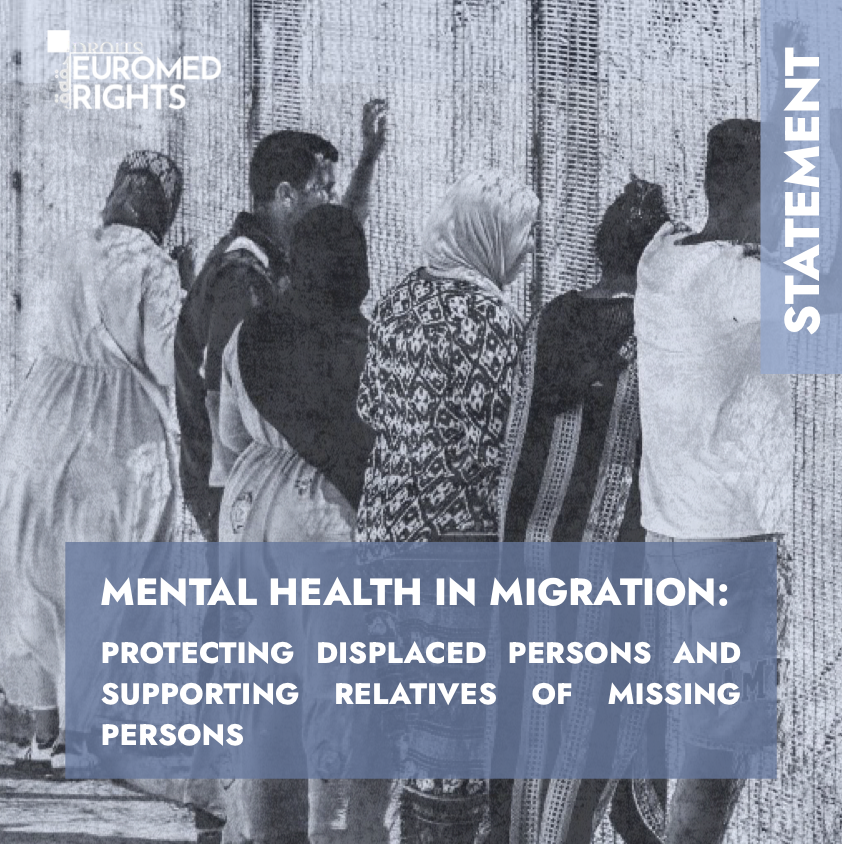
Following World Mental Health Day on 10 October, EuroMed Rights calls on States and competent institutions to make the mental health of people on the move and relatives of missing migrants a public health and human rights protection priority.
From violence encountered along the journey to reception conditions: suffering that persists
The mental health of migrants is shaped by experiences before departure, during the journey and after arrival. Conflict, persecution, violence and family separation leave their mark, sometimes compounded by detention, precarious housing, racism and uncertainty about legal status. Arrival in a transit or destination country does not necessarily put an end to the circumstances that undermine mental health.
In its report Death, Despair and Destitution, published in February 2024, Médecins Sans Frontières (MSF) brings together medical and operational observations, as well as testimonies collected in 12 countries across Europe, Africa and the Central Mediterranean. The organization describes the cumulative impact of European migration policies and practices on people’s health, well-being, and dignity. Its analysis links the violence encountered along migration routes to the confinement, precarious living conditions and exclusion experienced during transit and after arrival.
Médecins du Monde’s team also reports that symptoms of anxiety are prevalent among newly arrived migrants. Among those who spend longer periods in centers and have made several unsuccessful attempts to enter the European Union, they observe more symptoms of depression, apathy, and feelings of helplessness. They attribute these difficulties to prolong uncertainty, living conditions, violence at borders, and the breakdown of support networks. Recognizing psychological suffering does not mean assuming that all migrants are traumatized. Psychological distress must be distinguished from a diagnosed mental health disorder.
For relatives of missing persons, support must go hand in hand with the search for answers
Uncertainty takes on a particular dimension when a loved one goes missing during their migration journey. Without reliable information about their fate or whereabouts, families are left with unanswered questions. Pauline Boss describes this experience as “ambiguous loss”: the person is physically absent but remains present in the family’s psychological and emotional life. The hope of finding them and the fear that they may have died can coexist. Support must accommodate this uncertainty without pressuring relatives to accept an unconfirmed death or abandon their search.
The needs expressed by families demonstrate the close link between psychological suffering and institutional obstacles. The 2021 IOM report on families of missing migrants in Spain examines how legal frameworks and procedures concerning missing persons and unidentified remains can either facilitate or hinder families’ access to information and justice.
Ensuring effective care, protection and responses
EuroMed Rights calls on States, public authorities and competent institutions to:
- Guarantee effective and continuous access to mental health care, regardless of migration status, with access to qualified interpreters and support tailored to linguistic and cultural needs.
- Address the conditions that perpetuate suffering, including violence, discrimination, homelessness, family separation, and prolonged administrative uncertainty. This also means ending the detention of children.
- Ensure that support for relatives of missing persons goes hand in hand with an effective search for answers, by providing sustained psychological, social and legal assistance.
- Support associations and ensure the participation of those concerned, by funding local organizations and family associations and involving them in the design, implementation and evaluation of support systems.