
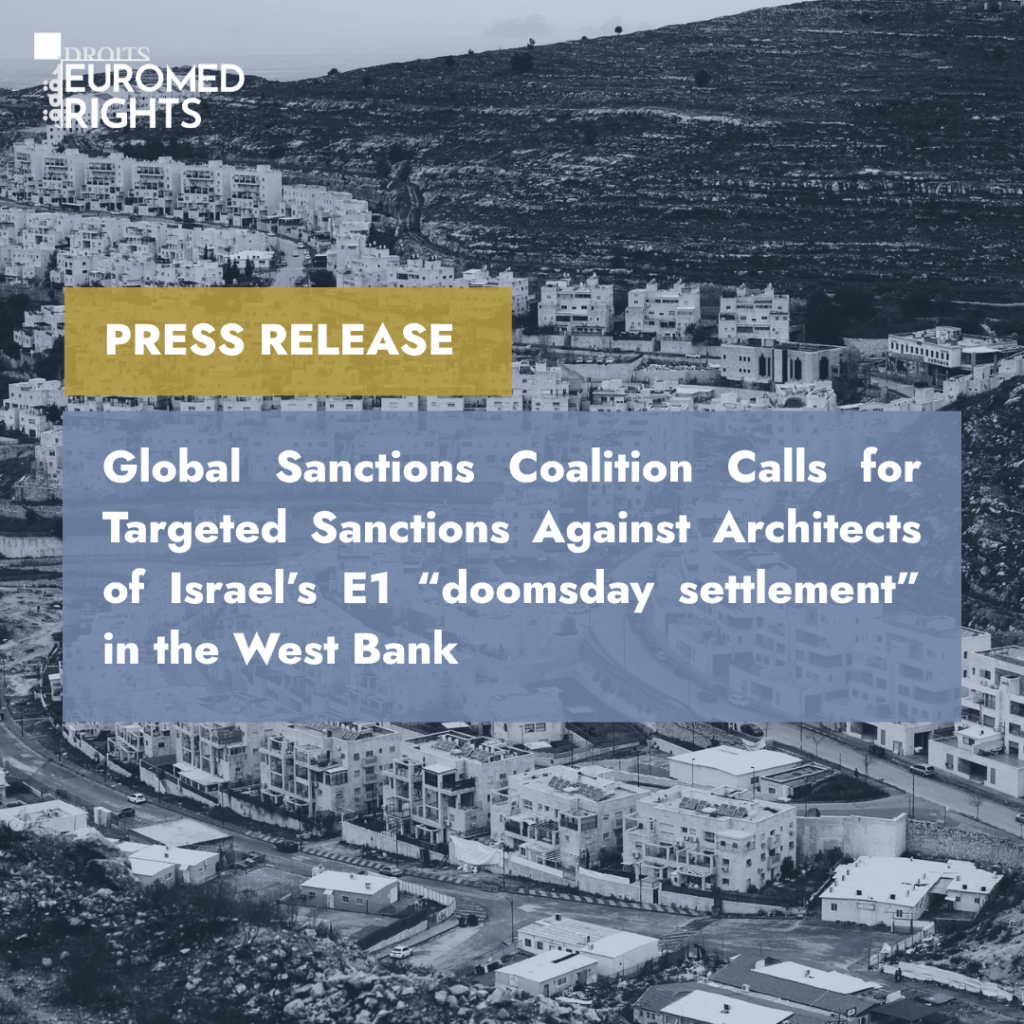
BRUSSELS, OTTAWA, LONDON, CANBERRA, The Global Sanctions Coalition (GSC) — a partnership of international civil society organisations coordinating sanctions submissions across jurisdictions submitted today its Stop E1 demand, calling on the European Union and its Member States to prevent Israel’s planned East 1 (E1) settlement expansion which threatens to sever the West Bank into disconnected enclaves and “bury the idea of a Palestinian State” under the EU Global Human Rights Sanctions Regime (GHRSR).
Israeli officials have not concealed the intent behind this project. Israeli Finance Minister Bezalel Smotrich called E1 development “how you kill the Palestinian state de facto.” Upon signing the framework agreement for E1 development, Prime Minister Netanyahu declared: “There will be no Palestinian State.”
Governments have a narrow window to act. Tender is open for construction on the E1 project and is set to close October 19, 2026, the week before Israeli elections. On September 17, 2026, the Israel Land Authority added a second tender for the remaining planned 2,167 E1 housing units. This second tender process is open for bidding until October 25, 2026, two days before incoming Israeli elections. This timing suggests a plan to finalize contracts for all E1 housing construction before any potential change in Government. Once the bidding process closes and contracts for E1 construction are awarded, experts warn of a point of no return. The E1 construction will proceed and the West Bank will be bisected on two separate axes, irrevocably undermining its territorial integrity and creating facts on the ground that extinguish the possibility of a Palestinian State.
A critical juncture
On 18 August 2026, the Israeli government issued a tender for 1,234 settlement units in the E1 area — just over a third of the 3,401 units approved as part of the wider E1 project in 2025.The project would connect occupied East Jerusalem with the Ma’ale Adumim settlement, severing the West Bank into two disconnected halves. The UN has warned that the plan would cut off Palestinian movement between the Ramallah/al-Bireh, Jerusalem and Bethlehem governorates, replacing free movement between them with a network of roads and tunnels under Israeli control. To complete the E1 development project, Israel plans to forcibly displace 18 Palestinian communities in the area, uprooting some 3,700 people to seize their land for segregated Israeli settlement use.
In August 2026, the EU institutions and a list of governments — including the European Commission, joined a statement describing the project as “unacceptable” and warning that companies bidding on E1 tenders would face “legal and reputational consequences.” Yesterday, during President Von der Leyen’s “State of the Union” (SOTEU) address, she reiterated that “The Israeli government’s decision to advance the illegal E1 settlement project is unacceptable”. GSC’s submission argues these warnings will remain symbolic unless they are matched by consequences for the officials approving, marketing and constructing the project.
Condemnation has not been enough
GSC welcomes the United Kingdom’s landmark decision, announced on 8 September 2026, to ban trade in goods from all Israeli settlements and to extend its own human rights sanctions regime specifically to allow faster action against E1. It shows what is possible when governments choose to act rather than simply condemn.
“The development of E1 is a state-directed project with identifiable, accountable individuals behind it, and is clearly and overwhelmingly recognised as illegal under international law. As such, and among many more actions, the EU must impose restrictive sanctions against its perpetrators” said Hamdi Shaqqura, Executive Committee Member at EuroMed Rights.
A sustained, escalatory approach amidst the collective fight for accountability in Israel/Palestine
While urging the EU and EU member states to immediately sanction actors materially responsible for advancing E1, the Global Sanctions Coalition also calls upon the EU and EU member states to initiate discussions on more structural measures, such as a dedicated Israel/Palestine sanctions regime, similar to the sanctions imposed on Russia over its occupation of Ukraine. As a matter of urgency, they also call on the EU and EU member states to issue clear public warnings to companies, financial institutions and other actors that participation in, or facilitation of, the E1 project will expose them to financial consequences and will prevent their access to European markets.
“At a time when the West Bank is once again on the verge of exploding and Israel, with complete impunity, seeks to eliminate the Palestinian presence there, sanctions should be a no-brainer,” says Willem Staes, Middle East expert at 11.11.11. “Anyone who takes a rules-based international order seriously and does not want to stand by passively while the ethnic cleansing of the West Bank unfolds before our eyes must take action now.”
The Global Sanctions Coalition (GSC) is a nonpartisan international alliance that mobilises civil society and allies across Europe, the United Kingdom, Canada, the United States and Australia to promote the effective and ethical use of economic sanctions. GSC’s mission is twofold: to ensure sanctions are precisely targeted to halt atrocities and malign conduct — including the expansion and maintenance of Israeli settlements in the Occupied Palestinian Territory — and to drive the recalibration of sanctions programmes that inflict harm on civilians or are otherwise inconsistent, biased or counterproductive. Visit globalsanctionscoalition.org to learn more.
Endorsers of this submission include, among others: EuroMed Rights, Pax Christi International, 11.11.11., Association France Palestine Solidarité (AFPS)
The sanctions file is available on request for members of the press.
Media contacts
EuroMed Rights – information@euromedrights.net
Note to editors
- The full sanctions dossier — including the legal basis for each proposed designation under the EU Global Human Rights Sanctions Regime (GHRSR) — is available on request. The same package is being submitted in parallel to the European Union and its Member States, and to the Governments of Canada, the United Kingdom and Australia.
- This is GSC’s third coordinated sanctions submission since it was launched in September 2025, when it first called for the designation of the World Zionist Organization, its Settlement Division and Israeli Minister of Settlements Orit Strook. A second package, submitted in December 2025, targeted three private companies involved in demolitions in Gaza. In spring 2026, GSC partners — including several of the organisations behind today’s submission — wrote jointly to EU High Representative Kaja Kallas and to individual Member State foreign ministers on E1, a letter endorsed by a broad range of European partners.