
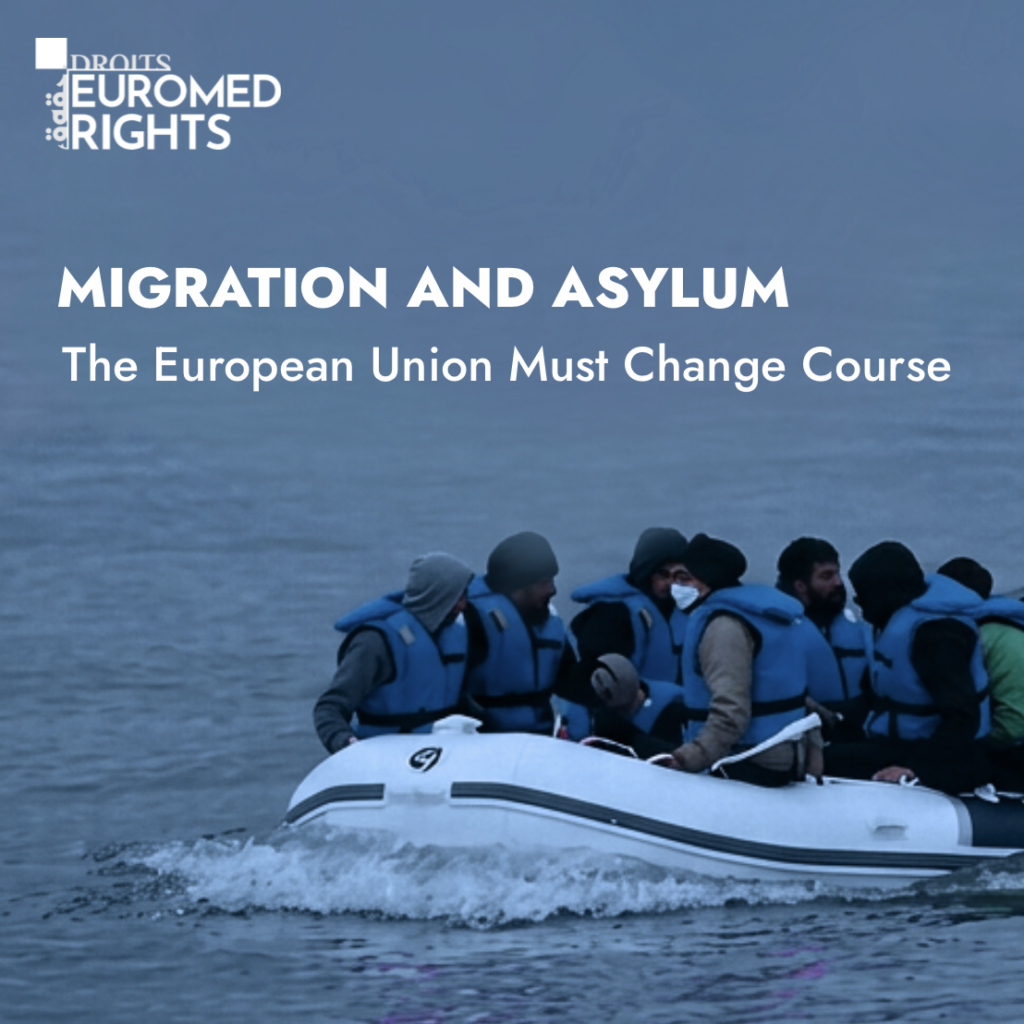
Members of EuroMed Rights’ Regional Working Group on Migration, Asylum and Economic and Social Rights warn against the direction taken by the European Union’s migration and asylum policies. Having become fully applicable on 12 June 2026, the EU Pact on Migration and Asylum fundamentally reforms the Common European Asylum System through a set of revised regulations and a directive. It forms part of a broader European strategy that places migration control, externalization, and returns at the core of its approach.
This strategy continues to unfold through new initiatives, including the revision of the EU return framework, the strengthening of cooperation with third countries, and the increasing use of migration conditionality. Taken together, these policies reinforce an increasingly securitized approach to migration management, based on externalization and returns, at the expense of the protection of people and respect for fundamental rights. They progressively shift the management of migration to third countries, multiplying the actors involved and blurring the lines of responsibility, precisely where human rights compliance, access to international protection, independent monitoring and accountability mechanisms are hardest to secure.
The consequences of these policies are already visible across the Euro-Mediterranean region. Cooperation with countries such as Egypt, Libya and Tunisia continues despite long-standing and well-documented serious human rights violations, including arbitrary detention, forced returns, violence against migrants and refugees, civic space shrinking and the criminalization of solidarity. By maintaining these partnerships, the European Union helps entrench these practices and the de facto externalization of migration management, while holding co-responsibility for the resulting human rights violations
As the EU Pact on Migration and Asylum enters its implementation phase across Member States, we, the members of EuroMed Rights’ Regional Working Group on Migration, Asylum and Economic and Social Rights, remain deeply concerned. Both the Screening Regulation (Regulation (EU) 2024/1356, Article 10) and the Asylum Procedure Regulation (Regulation (EU) 2024/1348, Article 43(4)) require every Member State to set up an independent fundamental rights monitoring mechanism covering screening and border procedures. Civil society organizations should also be involved, and where they are not, the mechanism must establish and maintain close links with them. Significant uncertainty therefore remains regarding the authorities responsible for these mechanisms, their independence, resources and functioning, and above all the role that will effectively be granted to civil society. Considering these uncertainties, we call for greater transparency, and the full, effective and independent participation of civil society throughout the implementation process.
These developments cannot be separated from an increasingly hostile political environment, marked by the rise of far-right narratives and their growing influence on European migration policies. This trend contributes to the gradual erosion of asylum protections, the shrinking of civic space, and the increasing criminalization of humanitarian assistance and human rights defenders, both within the European Union and across the Euro-Mediterranean region.
In light of these developments, a change of course is urgently needed. The Working Group calls on the European Union and its Member States to reorient their migration policies by placing human rights, international protection and respect for international law at the heart of their actions.
In particular, members of EuroMed Rights’ Regional Working Group on Migration, Asylum and Economic and Social Rights call on them to establish genuinely independent mechanisms to monitor compliance with fundamental rights, with the meaningful and structured involvement of civil society organizations; to make all migration-related cooperation and funding with third countries conditional upon effective human rights guarantees, including an independent human rights monitoring mechanism able to recommend the suspension of cooperation that contributes to human rights violations; to protect civil society organizations and human rights defenders from all forms of criminalization; and to expand safe and regular pathways for people on the move, ensuring effective access to international protection.
Migration policies cannot continue to be built around deterrence, externalization, and returns. They must be firmly grounded in international human rights, refugee and humanitarian law, ensuring that the rights, dignity, safety and agency of people on the move remain at the center of all migration policies.
Within the Regional Working Group on Migration, Asylum and Economic and Social Rights, we will continue our collective work to monitor these developments, document their human rights impacts and advocate for the rights of people on the move. Together, we will continue to amplify the voices of civil society organizations across the Euro-Mediterranean region and promote migration policies grounded in human rights, international protection, and solidarity.
List of signatories :
Fondation pour la promotion des droits
CNCD-11.11.11
Center for Legal Aid Voice
CIHRS (Cairo Institute for Human Rights Studies)
Irídia – Human Rights Defence Centre
Novact
CEAR (Comisión Española de Ayuda al Refugiado)
Tampere Peace Research Institute
FTCR (Fédération des Tunisiens pour une Citoyenneté des Deux Rives)
ARCI APS
CIR (Consiglio Italiano per i Rifugiati)
OMCT (Organisation Mondiale Contre la Torture)
DIGNITY
Tamkeen for Legal aid and Human Rights
ARM (Anti-Racism Movement)
PHRO (Palestinian Human Rights Organisation)
Mizal
IHD (Human Rights Association)
AMDH – Association Marocaine des Droits Humains
CS-LADDH (Collectif de sauvegarde de la Ligue Algérienne de Défense des Droits de l’Homme)
EEDDA (Comité Grec de Solidarité Démocratique International)
Mizan
Greek Council for Refugees
80:20 Educating and Acting For A Better World
Safe Passage International
Phenix Center for Economic & Informatics Studies