
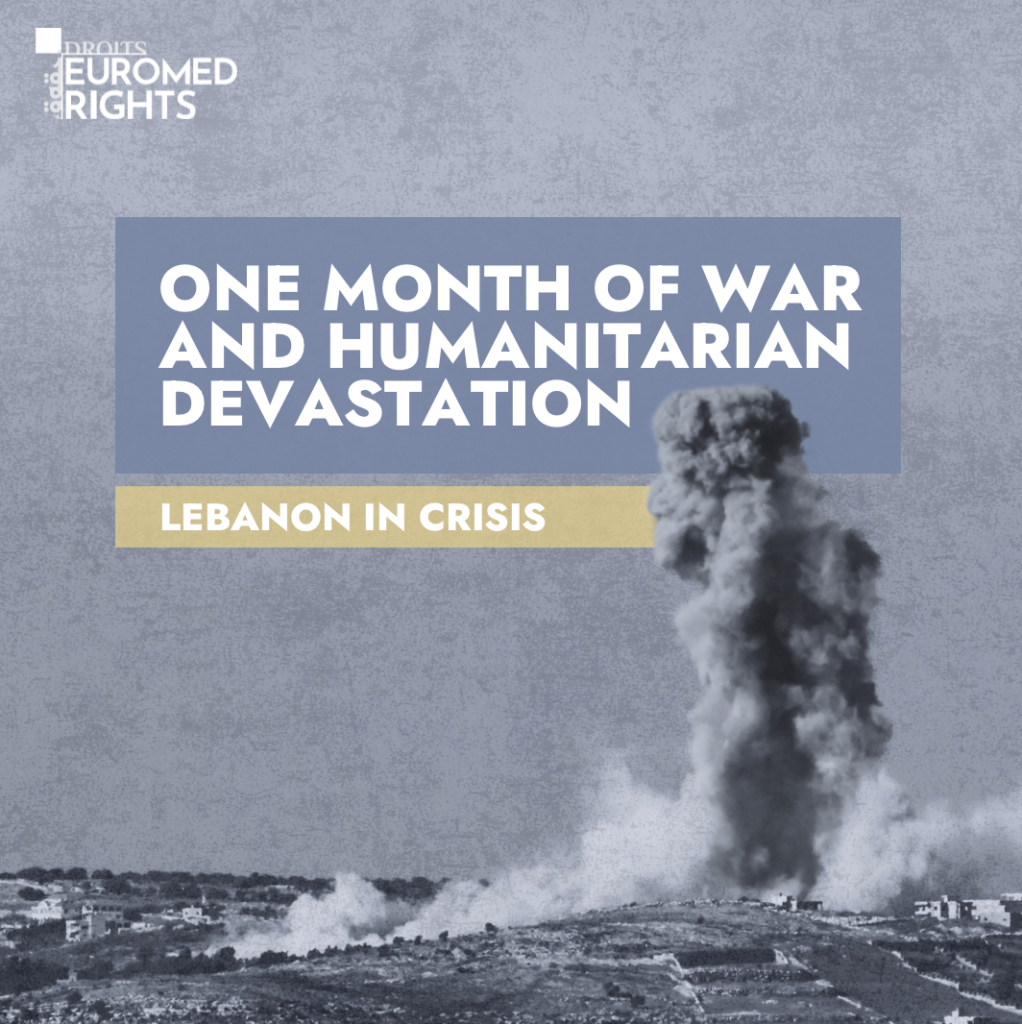
28 March 2026 marks one month since the onset of the war initiated by the U.S. & /Israel against Iran, which has rapidly escalated into a regional conflict. In Lebanon, over one million people has been forcibly displaced, while many others remain trapped in conflict-affected areas with little or no access to basic services. Civilian casualties continue to rise, with 1,142 people killed, including 122 children, and 3,315 injured as of 27 March 2026, according to the Ministry of Health.
Attacks on civilian infrastructure – including residential buildings, bridges linking southern Lebanon to the rest of the country, medical facilities, and essential public services- have intensified during this war, in direct contravention of International Humanitarian Law (IHL). As of 27 March 2026, 42 medical personnel have been killed and 119 injured. Emergency responders continue to operate under extreme risk.
On 22 March, Israeli Defence Minister, Israel Katz, stated on X that he and Prime Minister Benjamin Netanyahu had ordered “to accelerate the destruction of Lebanese homes in the contact villages in order to thwart threats to Israeli settlements – in accordance with the Beit Hanoun and Rafah models in Gaza”. This declaration comes as attacks intensify across multiple regions in Lebanon, including southern Lebanon, the Beqaa Valley, the southern suburbs of Beirut, and central Beirut.
The south continues to endure relentless attacks, with evacuation warnings affecting more than 70 villages and towns. Additionally, repeated evacuation warnings across nearly all of Beirut’s southern suburbs have resulted in the mass displacement of civilians.
Since the escalation oof hostilities that began in October 2023, violations of international law have persisted unbated, even after the ceasefire in November 2024. According to Human Rights Watch, since November 2024 there have been serious concerns regarding violations of international humanitarian law, including the reported use of white phosphorus in populated areas. When used in civilian settings, such weapons are inherently indiscriminate and can cause severe burns, long-term health consequences, and widespread fear among affected communities.
These violations constitute breaches of international human rights and humanitarian law, including the right to life, health, housing, and dignity.
In light of these grave concerns, EuroMed Rights calls on the international community to:
- Take urgent and effective measures to ensure the cessation of all attacks on civilians, including children and women, and residential areas.
- Ensure the protection of medical and humanitarian services. Hospitals, ambulances, healthcare workers, and humanitarian personnel must be protected at all times and allowed to carry out their work.
- Prohibit the use of indiscriminate weapons such as white phosphorus in populated areas and avoid any means or methods of warfare that cannot distinguish between civilians and combatants.
- Protect civilian infrastructure, including water systems, electricity networks, roads, and residential areas critical to civilian survival, particularly in Lebanon, where these services are already facing serious challenges.
- Take action to prevent the forced collective displacement of entire villages.
- Ensure accountability and justice by supporting independent investigations into violations of IHL and human rights law, and by holding perpetrators accountable.
- Prioritise ceasefire negotiations to prevent further civilian suffering and regional destabilisation.